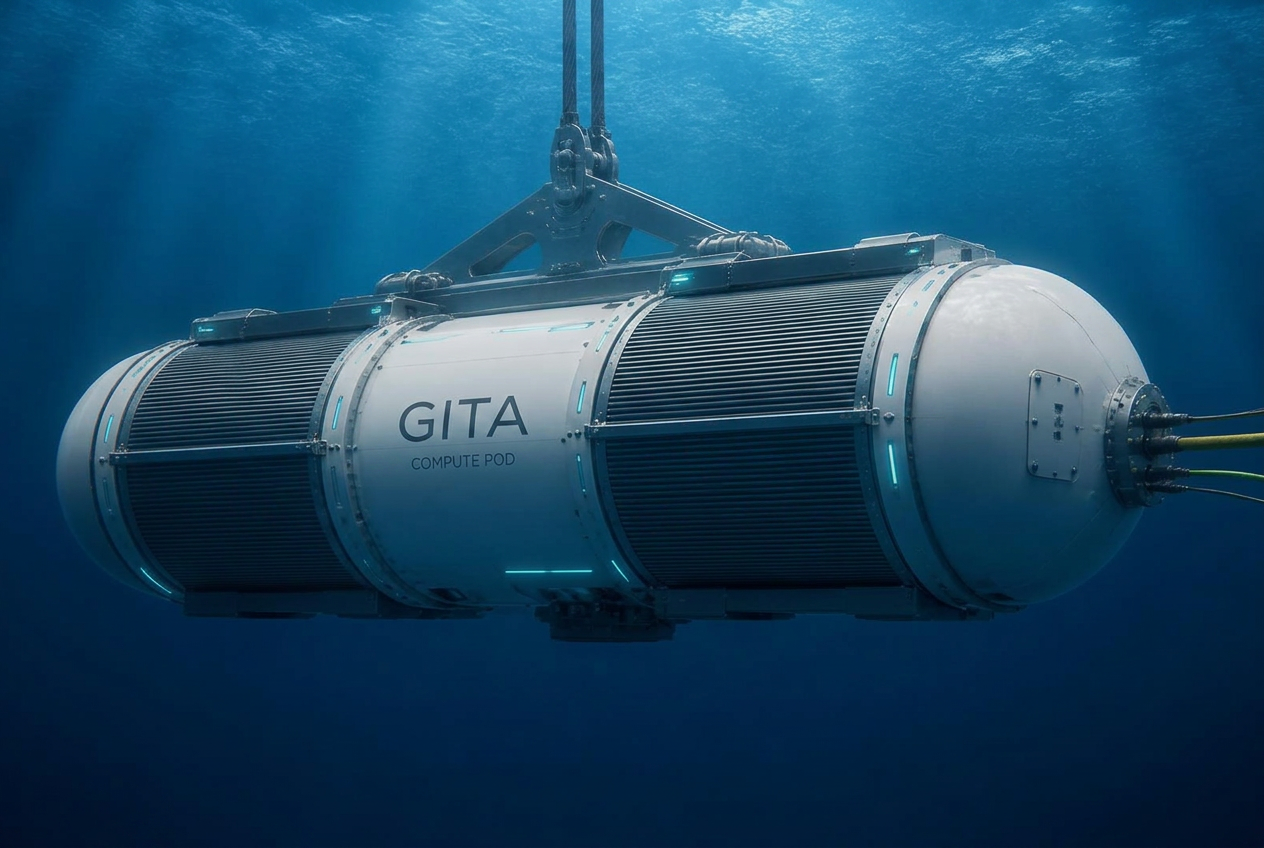
GITApods — Global Intelligent Transoceanic Architecture
The ocean is where
compute belongs.
AI has outgrown the land. GITA builds sealed, factory-made underwater data center pods cooled by the sea and deployed where power and fiber already meet the coast.
DescendThe bottleneck
AI capacity is no longer limited by chips or capital. It is limited by cooling, power and permits.
~2%
of global electricity already consumed by data centers (IEA, 2024)
100 GW+
of grid interconnect queues in the UK and US alone
Years
of permitting and construction lag behind each hardware generation
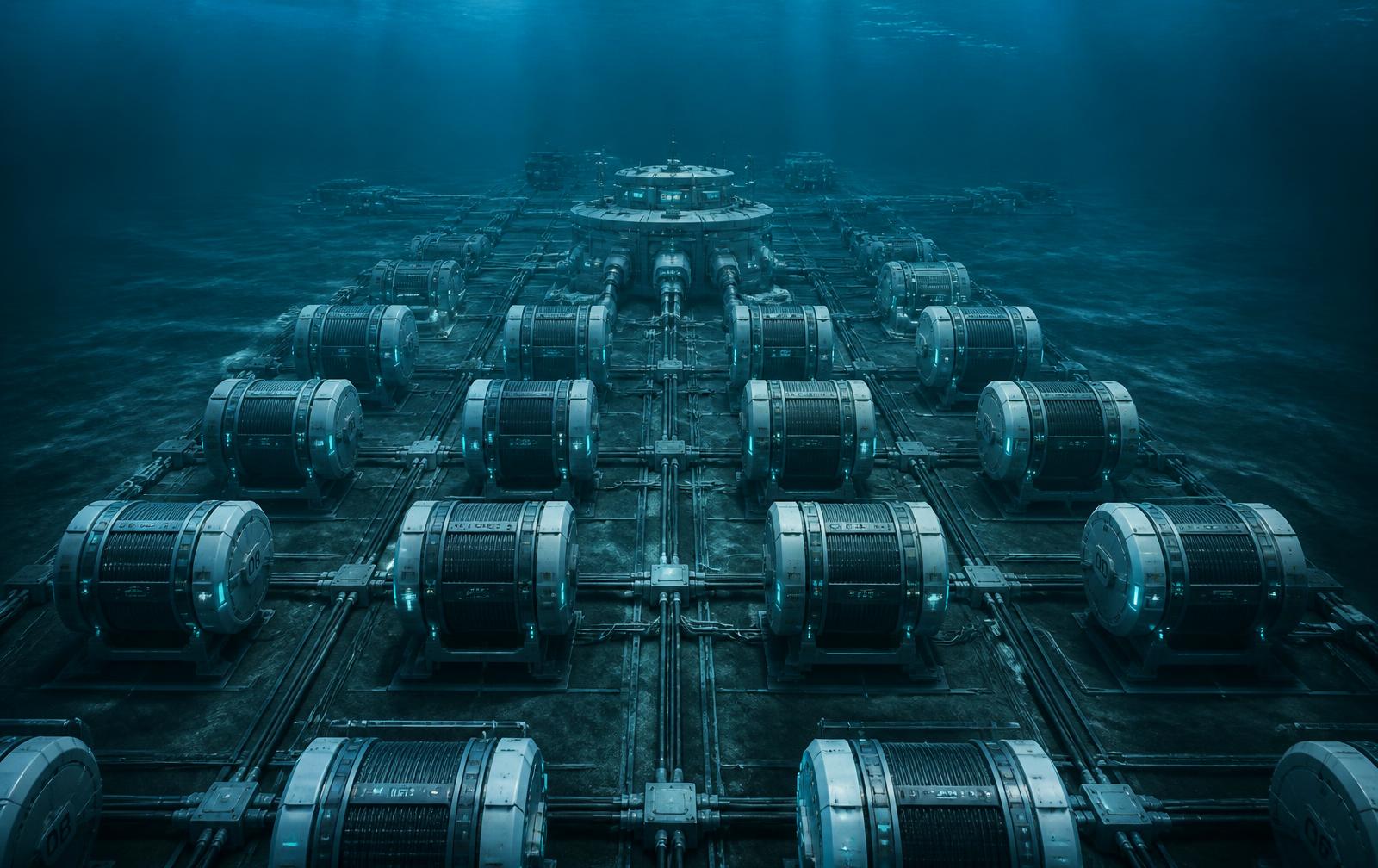
Why underwater
The planet's largest untapped thermal sink.
01
Immense heat capacity
No evaporative loss, no cooling towers, no water consumption. The sea absorbs what land cannot.
02
5–15 °C, always
Stable ambient temperature at moderate depth allows heat rejection across a small delta-T.
03
Low vibration, no dust
Quiet, sealed, contaminant-free environments — the conditions electronics are happiest in.
04
Zero land footprint
No construction congestion near population centers. Minimal onshore presence, low permitting friction.
Marine stewardship
The ocean is the platform. We keep it alive.
01
Closed-loop cooling
Seawater circulates through heat exchangers and returns within a few degrees of ambient. No chemicals, no biocides, no thermal plume.
02
Quiet by design
Low-flow hydraulics, anti-fouling coatings and anchored siting keep acoustic and physical disturbance far below active shipping lanes.
03
Co-designed with ecologists
Every site is screened against marine protected areas, migration corridors and benthic habitat maps. Sensors report back continuously.
The pod
A pressure hull, a dry inert atmosphere, and a sea full of coolant.
Marine-grade alloy hulls rated to 200 meters hold compute sleds, power conversion and networking at near one atmosphere. Plate heat exchangers move waste heat straight into ambient seawater. Anti-fouling coatings and cathodic protection carry the pod through multi-year service intervals; ROVs handle inspection and wet-mate cable swaps.
Power per pod
5–20 MW
Operating depth
10–200 m
Effective PUE
1.05–1.15
Service interval
3–5 years
Reliability vs. land
×8
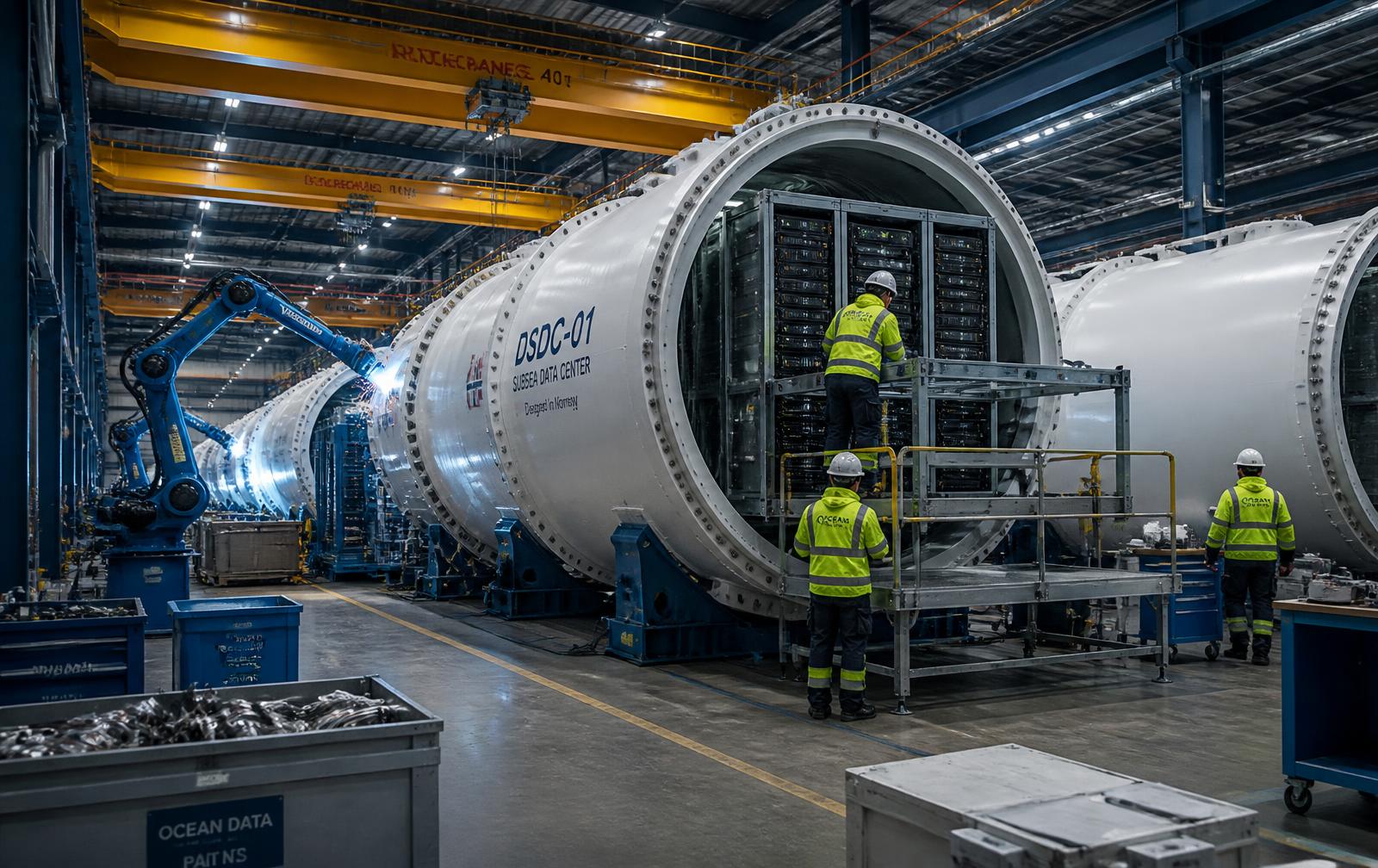
Factory to commissioned
<12 months
Deployment
Modularity is the siting strategy.
01
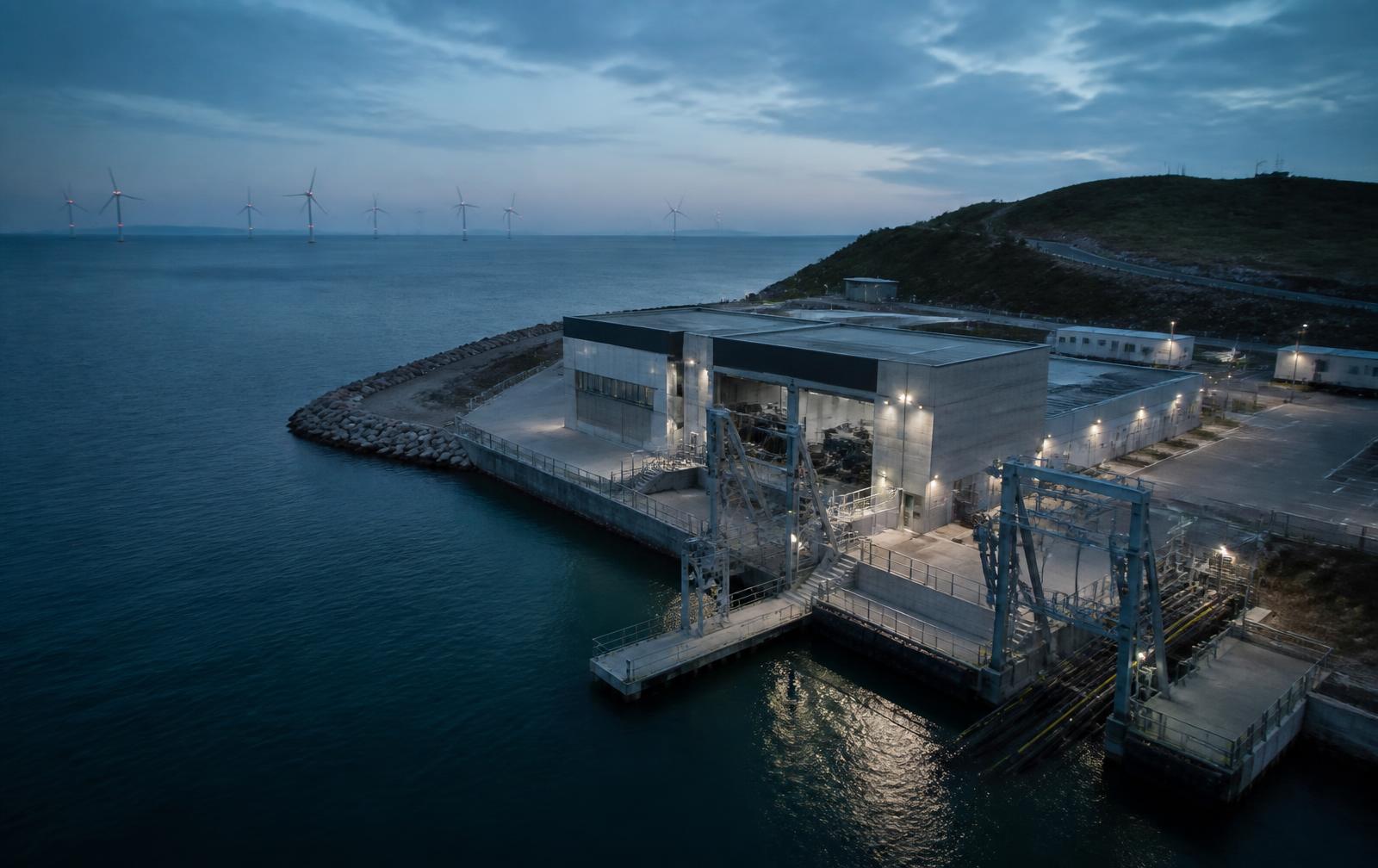
Near-shore pods
Anchored 1–5 km offshore at 10–80 m depth, tied directly into coastal substations and fiber landings. The pilot configuration.
02
Cluster arrays
Multiple pods arranged around a shared hub aggregating power and data trunks. Scalable past 100 MW.
03
Barge platforms
Pods mounted to floating or semi-submersible structures that relocate with demand and political geography.
04
Hybrid extensions
Existing land campuses extended by offshore pod rings — incremental capacity without new permits.
Ocean vs. orbit
Space is scalable but distant. The ocean is close, and available now.
| Dimension | Orbital compute | GITA pods |
|---|---|---|
| Cooling | Radiative — 22,000 m² for 10 MW | Seawater — under 1,000 m² for 10 MW |
| Latency | High latency, limited uplink | Millisecond latency over fiber |
| Deployment cost | > $3,000 per kg to LEO | < $5 per kg by sea |
| Maintenance | Robotic only, unrecoverable | ROV service, retrievable pods |
| Time to revenue | 10–20 years | 1–3 years |
Unit economics
Each pod is a standalone infrastructure asset.
Revenue arrives through long-term offtake contracts with AI labs and telcos, a spot market for overflow and sovereign workloads, and licensing of the pod design to regional partners.
~$6M
capital intensity per MW, comparable to terrestrial hyperscale
<$30M
to fabricate and deploy a 5 MW pod
≈4 years
modeled payback at 85% utilization and $0.05/kWh
>15%
IRR per pod, improving with shared cluster infrastructure
Roadmap
From design freeze to a global template.
2026
Design freeze. Marine, chip and energy partnerships. Regulatory pre-applications.
2027
Fabricate and deploy the 5 MW pilot pod. Six-month soak test, marine data collection.
2028
Commission the first 25 MW commercial cluster, integrated with an offshore wind PPA.
2029
Multi-region operations at 100–200 MW. Sovereign compute programs launch.
2030+
GITA pods standardized as a global template. Deep-water and Arctic siting explored.
Call to action
The compute frontier is already on this planet.
GITA is raising alongside marine, chip and energy partners to fabricate the first pilot pod. If you build, power, regulate or consume compute at scale, we should talk.
Contact us